Civic Interplay explores acts of civic care, relationality and custodianship in an era of agentic AI and AI sovereignty.
It is a think and do space. It is all work in progress.
If times have become strange - agentic, worrisome - the nature of enquiry need not be without play.
This is not a space where outcomes are pre-determined. Where theory informs action. What is known is no longer, necessarily, the ground on which we act.
The ‘Macro Age’ We’re Living Through
We are living through the Sixth Mass Extinction, the rise of AI sovereignty, and a series of catastrophic climate tipping points.
The speech-acts: what have they become?
Units of attention to be hard-earned, quantified outputs to be reported, inputs to a hyperscaler’s model?
All Media is Training Data, as Holly Herndon and Mat Dryhurst would say.
The city is an LLM.
Global Governance?
Multi-lateral institutions have given way to a planetary AI now governing the logics of information, computation, and increasingly, co-intelligence.
If this is a macro-age, what does it feel like to be a citizen? Does citizenship still matter?
The macro age we find ourselves in is creating, before our eyes, a different kind of history.
It’s not the kind of history we were taught before. We can no longer say: And then they lived comfortably ever after.
We are not so sure of that any more.
But we can say: We are the interface for a new politics of becoming.
By ‘interface’, we mean something specific: we are the living, sensing, semi-autonomous connection between the world as it has been and the world as it might become.
Through our daily choices, we are actively training the planetary intelligences that shape material futures.
Which platforms to use, which data to share, which automated systems to trust or resist, what terms and conditions we say yes to, what model we sign our allegiance to.
This is the role playing asked of us during these emergent years of the agentic age.
This is the micro politics of civic interplay.
Examining the civic interface we are becoming, and what forms of civic action and intention have a role to play in the story of global AI governance.
Beyond legacy models
How to think about AI governance from the ground up.
The language of digital computing is suffused with legacy models:
‘Cloud computing’, as though our data had no weight, no carbon cost, no material infrastructure spanning the earth
’Human-centred design’, as though humans are the only thing that matters in a more-than-human world facing ecological collapse
’Artificial intelligence’, as though it is somehow not real, or not borne of the collective wealth of knowledge
’Information design’, as though designing how information flows were not also political acts
What about instead:
Our interconnected lives operate as training grounds for a new kind of planetary intelligence. The question is not whether we’ll have planetary-scale AI systems. We already do. The question is what kind of citizens we’ll be in relation to them.
What about instead:
The institutions to which we owe our allegiance and identities as citizens are becoming strange.
It is not only ‘governments’ as we have known them, but ‘governing bodies’, extending beyond these formal states, upon which we have become interdependent, in both cognitive and infrastructural ways.
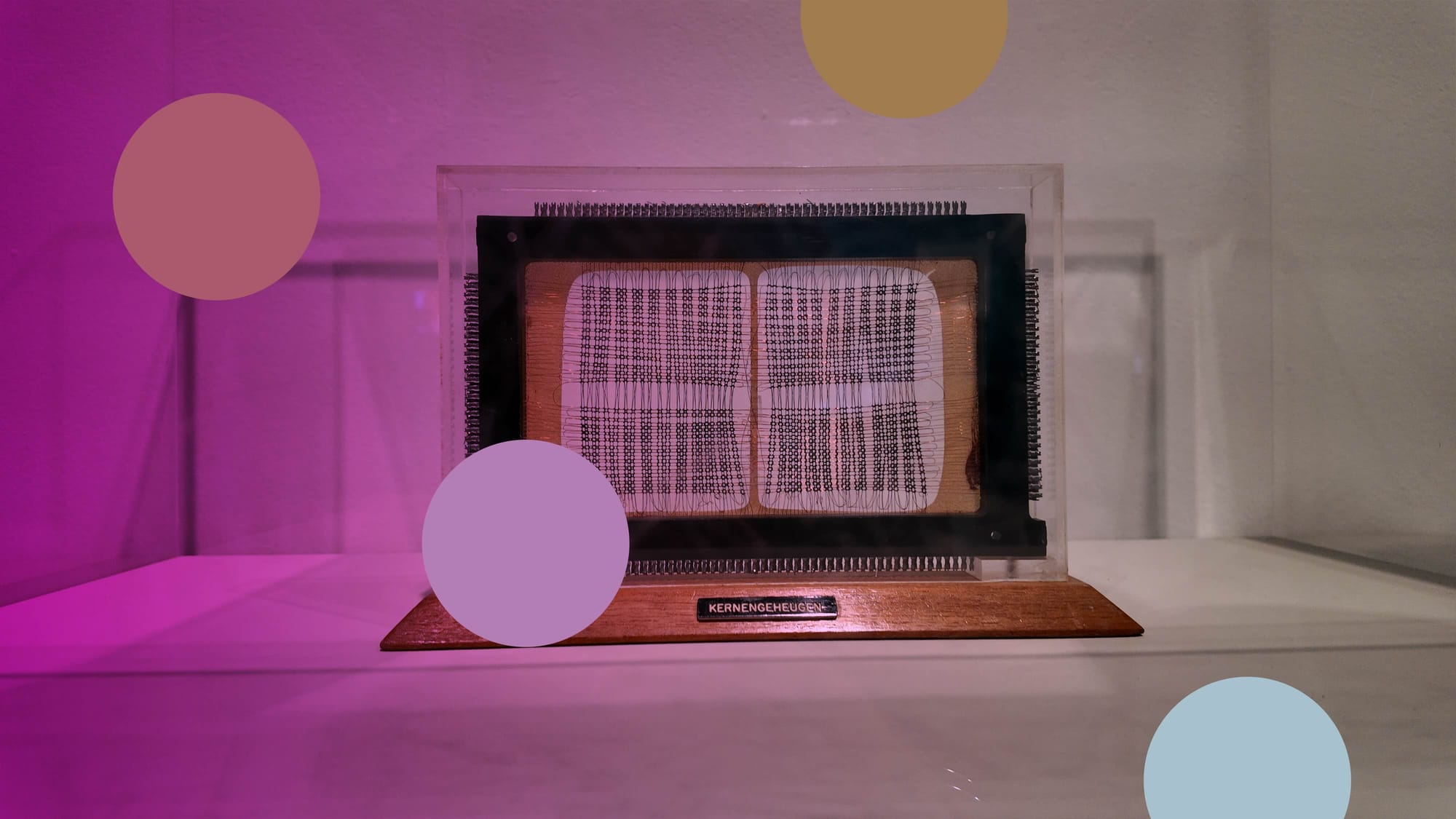
Magnetic Core Memory, early IBM computer. Memory like this was woven by hand, each ferrite ring threaded onto crossing wires, the work done overwhelmingly by women. The loom sits closer to the history of computing than the metaphor lets on: the punched cards that ran the first machines were borrowed from the Jacquard loom. Image from Women as Technology exhibition, Design Museum Den Bosch. Photo by Sarah Barns, 2025.