Civic Interplay / Tracker
Data Centres Sovereignty Tracker
A living atlas of infrastructural AI in Australia. Site by site, it records who owns the compute, what each facility draws in power and water, how it was approved, where it has been contested, and which supply chains it depends on. The tracker is open: the code base is on GitHub, alongside summary data sheets for each State and Territory, a glossary, a methods statement and a news feed (RSS).
If the map does not load, your browser may be blocking the embedded site. Open it in a new tab instead.
This project examines data centre approvals in Australia as a contested terrain, reflecting competing versions of agency and sovereignty that are expressed by place-based communities.
The tracker is the first practice-based methodological expansion of civic AI by researcher and digital strategist Dr Sarah Barns (RMIT University). It uses AI skills and methods to make flows of public value more accountable and legible, while also examining the extent to which current practices of data governance support the goals of transparency and democratic accountability.
A core proposition being tested here is that digital tools, including AI agents, can be used to expand and democratise how public policies are understood and interpreted for their impacts on places over time.
However, their effectiveness also depends on a set of core digital capabilities and services that require concurrent investment for this methodology to be practical and meaningful. These include: open and machine-readable data infrastructures, commitment to open and transparent reporting around public value and accountability, and digital literacies around platform dependencies and their consequences for digital agency, including AI agency.
Civic AI applied to data centre approvals
Combined with a place-based approach, the tools of civic AI are being adopted to interrogate how public policy frameworks are adapting to a ‘super cycle’ wave of infrastructural AI investment in Australia.
Key focus areas for this Data Centre Tracker include:
- comparative levels of data transparency across states and territories;
- forms of governance practised in the approvals process;
- levels of data transparency relative to purported claims; and
- expressions of civic agency evidenced through the formal public approvals process.
The methodology operates as a form of recursive listening, where sites of urban transformation are read as informational archives, structured and interpreted through distinctive methods for listening, attention, interpretation and gathering over time (including information gathering).
Attention to this dimension of urban transformation is designed to foster greater awareness of the role and value of informational transparency and accountability in shaping good governance and decision making on behalf of current and future generations.
Mapping AI sovereignties
Core to this tracker is the recognition that AI sovereignty is mobilised as a highly normative term that supports the accumulation of value, public and private, around investment in AI infrastructure globally.
However, AI sovereignty as a framework mobilised to support investment in AI infrastructure and skills also operates to undermine existing practices of sovereignty, including place-based sovereignties: Country-centred and local community sovereignties.
Negotiations over contested versions of sovereignty occur at the site of data centre approvals, where local and state-based planning regimes approve large-scale data centres supported by vast global investment flows, as well as national sovereignty actors in the form of sovereign wealth funds and superannuation funds.
National policies also advance national sovereignty goals for digital infrastructure through public policy settings including, in Australia, the Foreign Investment Review Board (FIRB) and spending on public compute.
Each of these layers reflects different values towards the nature of digital sovereignty, and in particular AI sovereignty, and each is a focus for this tracker.
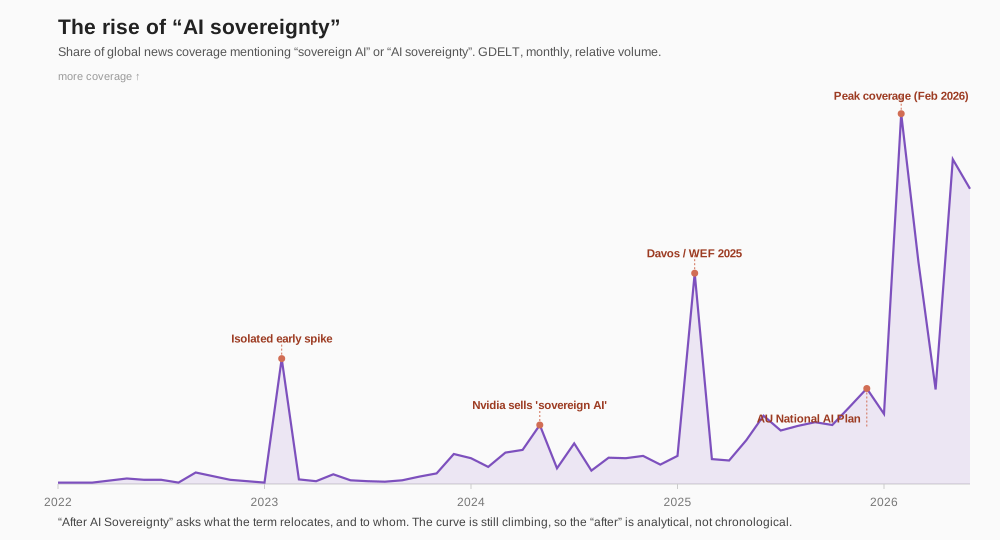
Global news coverage mentioning “sovereign AI” or “AI sovereignty”, relative volume, 2022 to 2026. Source: GDELT. Data and method in the project explainer.
Key findings and methods
In Australia, dependency on global cloud providers is a condition of participation in AI infrastructure. This is reflected in the reliance on the US frontier model developer Anthropic in the development of this civic AI methodology (noting that alternative models are also available).
Tracking the approvals of data centres in Australia (view the map), the project identifies key trends in both approvals and data transparency, alongside summary data sheets by state and territory and news reportage, and the full contestation record in Notion. A summary of the methodology adopted for the project is below, with an accompanying glossary of key terms, the fact-checking protocol used for human verification, a GitHub repository and a DOI for citation purposes.
Platform dependencies
The tracker depends on parts of the stack it maps, and it records that dependency.
- Anthropic. Claude is the model behind the research agents. Sites in the tracker listed as hosting, or planned to host, Anthropic’s models in Australia include AWS Asia Pacific (Sydney), Amazon’s Sydney and Melbourne investment, Google Cloud Sydney and Melbourne, and the proposed Western Downs Digital Park near Dalby (lease subject to FIRB approval).
- Notion holds the database. All data can be exported at any time.
- MCP and public APIs connect the tools.
- Cloudflare and Mapbox provide hosting and base maps.
- Factiva provides licensed news through an RMIT licence. It is read by hand, never scraped.
- GitHub holds the code, data and documentation. Each version is deposited on Zenodo with a DOI.
Accounting for compute costs
The project also runs a tracker of the reported computational costs of the research, in the Cost of Compute tracker, and the same records are saved in the GitHub repository.
Related reports and presentations
- Submission to the Senate inquiry into AI and data centres (1 September 2026), with fourteen recommendations
- Mapping Australian Data Centres: the story behind the map
- Barns, S. (2026). Rethinking the AI stack from the ground up, through recursive monitoring methods. Conference paper, Data for Policy 2026, Barcelona, 8–10 September 2026.
- American Association of Geographers Annual Meeting, San Francisco, April 2026 (slides, PDF)
- Dataset on Zenodo: every version of the tracker data, citable with a DOI
Citation and licence
Sarah Barns, A living atlas of contesting and curating AI sovereignties (Australian view), Civic Interplay, 2026. doi.org/10.5281/zenodo.21026429
The methodology, classification and written analysis are licensed under CC BY 4.0. The underlying records are compiled from public sources and cited per entry; the facts themselves carry no licence claim. Sourcing and classification are set out in the project explainer and, in fuller form, the methodology statement.
For research partnerships or use of the data in publication, get in touch.