Civic Interplay / Field note
An infrastructural-AI stack
An AI system is not one thing. It is a stack of six layers, and different people own each one. This is what that looks like in Australia, from the minerals in the ground to where the profit is finally booked.
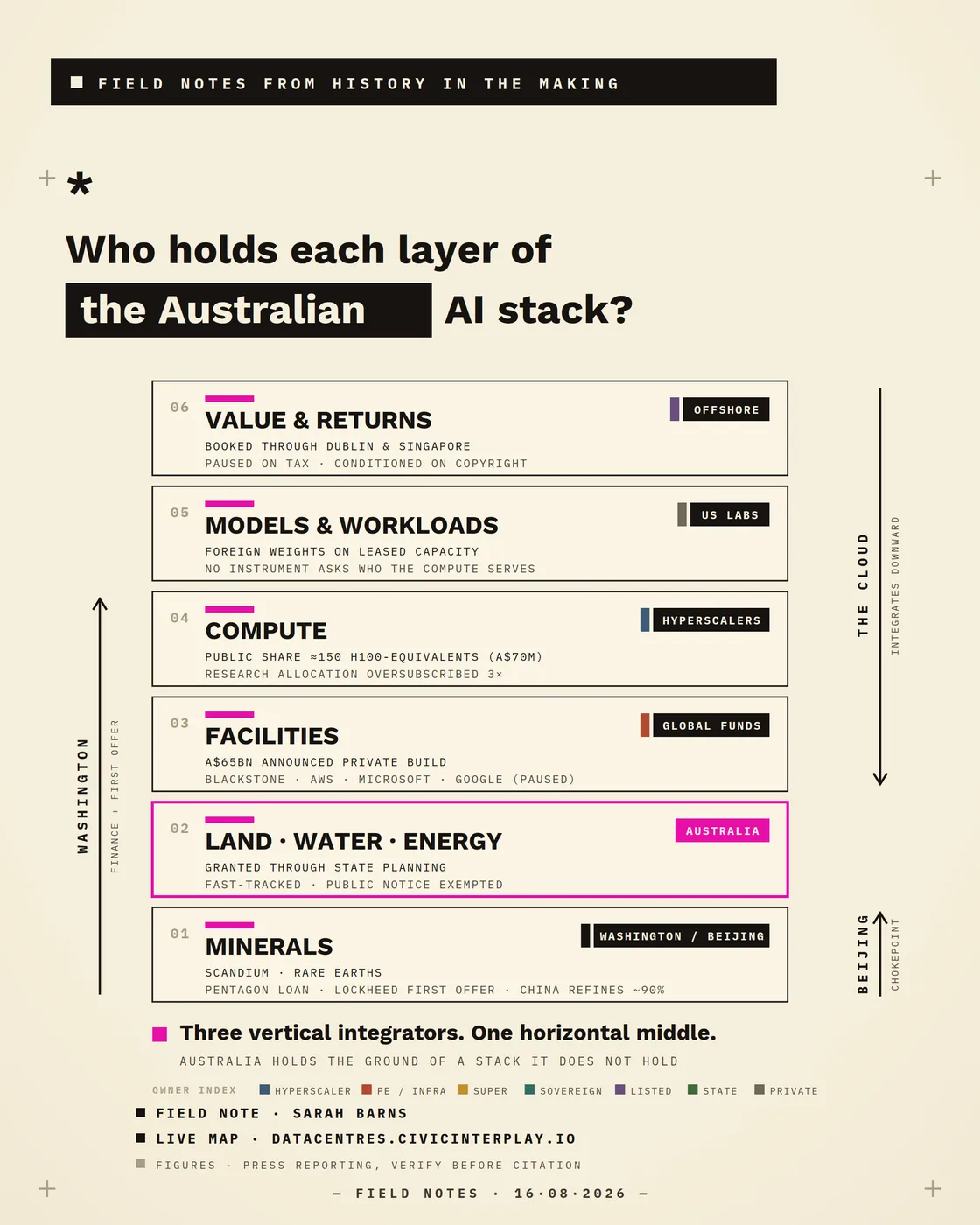
- 06 Value & returns Booked through Dublin and Singapore. Paused on tax, conditioned on copyright. Who holds it Offshore
- 05 Models & workloads Foreign weights running on leased capacity. No instrument asks who the compute serves. Who holds it US labs
- 04 Compute The public share is roughly 150 H100-equivalents, about A$70 million. Research allocation is oversubscribed threefold. Who holds it Hyperscalers
- 03 Facilities A$65 billion of announced private build. Blackstone, AWS, Microsoft, Google (paused). Who holds it Global funds
- 02 Land, water, energy Granted through state planning. Fast-tracked, with public notice exempted. Who holds it Australia
- 01 Minerals Scandium and rare earths. A Pentagon loan, Lockheed holding first offer, and China refining around 90 per cent. Who holds it Washington / Beijing
The short version
Three vertical integrators, and one horizontal middle. Australia holds the ground that the stack is built on, and almost nothing above it. The layer granted through state planning is the layer where public notice is exempted, which means the one part of the stack under Australian control is also the part decided with the least public involvement.
Read the stack from the bottom up and it is a story about resources. Read it from the top down and it is a story about where the returns go. Both readings end in the same middle, and that middle is the only place a state government currently has leverage.
Figures are drawn from press reporting. Verify before citation. If you find an error, the correction form below goes straight into the tracker.
What to do with this
The useful question is not who is to blame, it is where the leverage sits. Layer 02 is the answer, because it is the layer a state or local government actually decides. The companion field note sets out what could be asked for at that point of decision.
Cite this
Barns, S. (2026). An infrastructural-AI stack. Civic Interplay. https://doi.org/10.5281/zenodo.21026429
Licensed CC BY 4.0. Reuse it, adapt it, build on it. Attribution is the licence condition, and it is also how this work gets counted. Last revised August 2026.
Running this somewhere? Tell us where and it goes on the public register.