Civic Interplay / Field note
What could a community actually ask for?
When a data centre is proposed nearby, the conversation usually stops at jobs and rates. This is a longer list. Eight rungs, running from compensation at the bottom to co-ownership at the top, and every one of them names a mechanism that already works somewhere in the world.
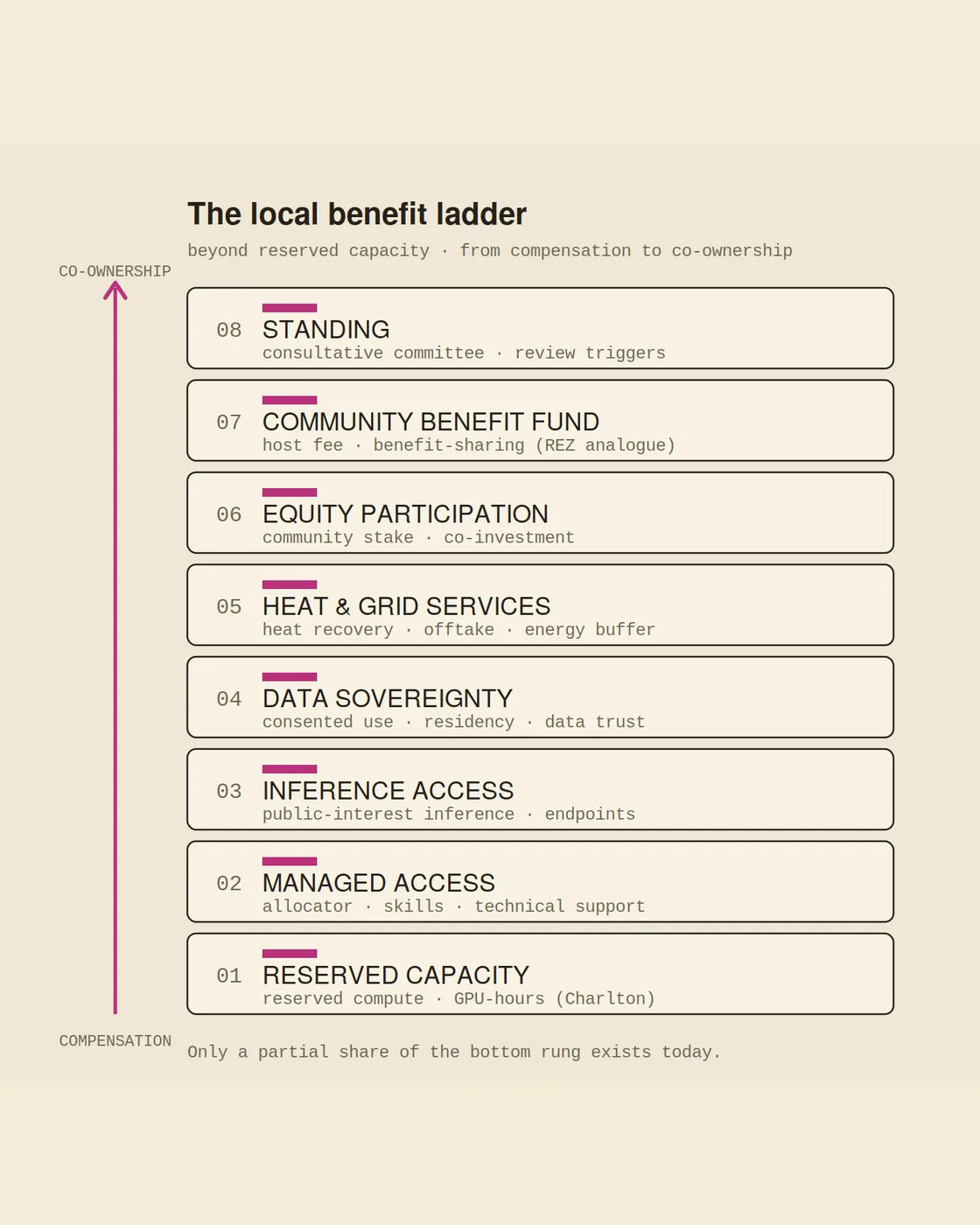
- 08 Standing A consultative committee with review triggers, so the community has a seat that persists after approval. Drawn from Community Consultative Committee NSW Planning (DPHI), major-project planning
- 07 Community benefit fund A host fee paid into a local fund, on the model already used for benefit-sharing. Drawn from Benefit-sharing payment, $1,050 per MW per year EnergyCo NSW, renewable energy zones
- 06 Equity participation A community stake in the facility itself, through co-investment rather than compensation. Drawn from Co-ownership models (Power in Partnership) Community Power Agency, community energy
- 05 Heat and grid services Waste heat recovered and sold on, plus offtake and energy buffering back to the grid. Drawn from Waste-heat offtake to district grid Stockholm Exergi, district heating
- 04 Data sovereignty Consented use, data residency, and a data trust governing what the facility may hold. Drawn from Kaitiakitanga data licence Te Hiku Media, Aotearoa New Zealand
- 03 Inference access Public-interest inference endpoints, so local institutions can actually use the compute. Drawn from AI Factories access commitment EuroHPC Joint Undertaking, public AI Adjacent precedent, verify before use
- 02 Managed access An allocator, plus the skills and technical support to make an allocation usable. Drawn from National Merit Allocation Scheme NCI, ANU, research computing Adjacent precedent, verify before use
- 01 Reserved capacity Compute reserved for local use, counted in GPU-hours. Drawn from Domestic Gas Reservation Policy WA Government, gas and resources
Why a ladder
A ladder rather than a list, because the rungs are not equivalent. The bottom of the ladder is compensation: something given in exchange for accepting the facility. The top is co-ownership: a share in what the facility is and does. Most negotiations never leave the bottom rung, and often not even all of it.
Only a partial share of rung 01 exists in Australia today. Everything above it is drawn from somewhere else, which is the point. None of this is invented. It is a matter of applying instruments that already exist in energy, in resources, in research computing and in Indigenous data governance to a kind of infrastructure that has so far escaped them.
Two rungs are marked as adjacent precedent. They are close analogues rather than direct ones, so the framing needs checking before it goes to a state government. The other six are in force somewhere today.
Using it
The ladder is most useful as a checklist in a room. When a proposal is on the table, work up from rung 01 and ask which rungs are being offered, which are being refused, and on what grounds. A refusal at rung 07 is a different conversation from a refusal at rung 02, and naming which rung you are on tends to move a negotiation faster than arguing in general terms.
It also pairs with the stack. The stack shows where the leverage sits, at the land, water and energy layer that a state or local government decides. The ladder is what to ask for once you are standing there.
Cite this
Barns, S. (2026). The local benefit ladder. Civic Interplay. https://doi.org/10.5281/zenodo.21026429
Licensed CC BY 4.0. Reuse it, adapt it, build on it. Attribution is the licence condition, and it is also how this work gets counted. Last revised August 2026.
Running this somewhere? Tell us where and it goes on the public register.